
|
Why this topic, and why now?
We can best answer that just by browsing through a newspaper any
day of the week. We live in a culture which still has a memory of
God, but worships at the altar of practical materialism. As a result,
we're pulled between two great polar sins: pride in our economic,
political, financial and technological power over the world around
us; and despair over the limits of our power and the constant
threat of losing the limited power we have. In the developed countries
especially, but also throughout the world, it's a time of immense
anxiety, excess and coarsening of attitudes toward the sanctity
of life. One small example: American news media recently reported
that legislators in Belgium have demanded that the government should
end its ban against euthanasia . . . because doctors and patients
routinely ignore it anyway. This, in an overwhelmingly "Catholic"
nation; a nation where the standards and satisfactions of living
are envied by much of the world.
To paraphrase Scripture: Without hope, the people perish. Against
this culture of emptiness and self-destruction, John Paul II has
fixed his eye on the Great Jubilee since the day of his election
20 years ago. Preparing the Church to better serve God as a beacon
of hope in the new millennium has always been one of his goals.
To do that, he has systematically submitted every aspect of Catholic
life to review and renewal in light of Vatican II a council
whose heart he knows from personal experience. As the lineamenta
document suggests, the synod in 2000 will conclude a profound and
comprehensive review of Church life as a communion in Christ
for the evangelization and salvation of the world.
The process began in 1987 with the synod on the laity. It continued
through 1990 and 1994 with synods on the priesthood and consecrated
life respectively. Now it reaches completion in examining the vocation
of the bishop, who "is the principle and visible source of unity
in the Church entrusted to his pastoral service" (4). Over the past
decade, then, the Holy Father has carefully affirmed the dignity
and explained the role of each state of life in the
Church. Or to say it another way, he's put our family affairs in
order, the better to accomplish the work we're all called to do,
as a family of faith, in the new age before us.
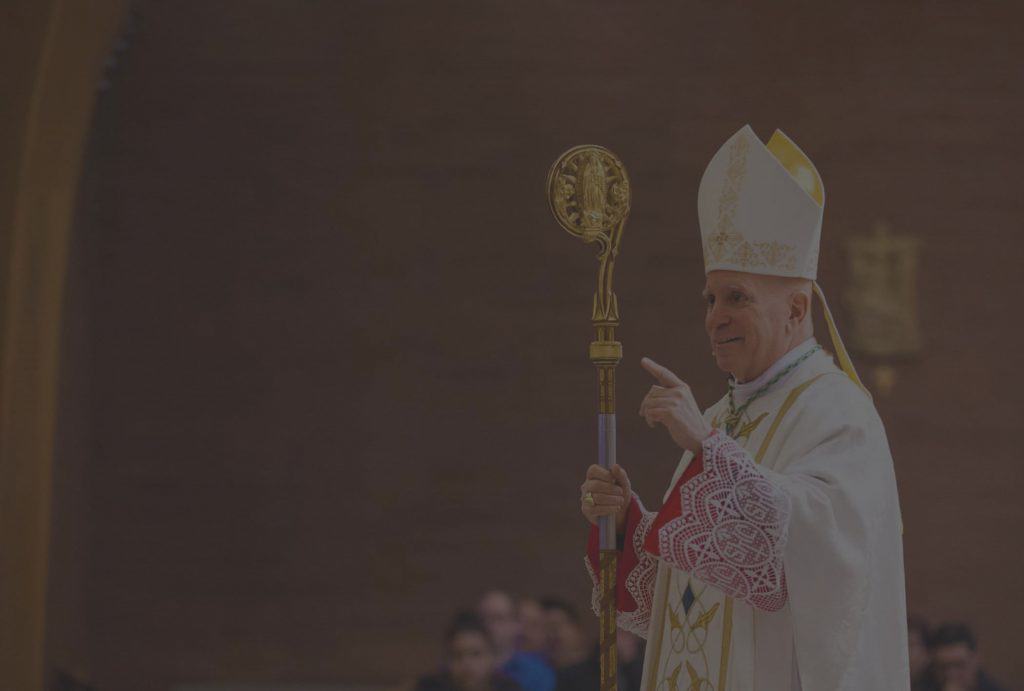
Every bishop is the "father" of his local family of faith. It makes
sense, therefore, that the Pope's review should finish with a reflection
on the vocation of bishops, who bear a special responsibility for
the mission of the Church. In that regard, the synod's official
theme is itself a small catechesis. The bishop is first of all a
servant. His authority does not come from power, personal
achievement or popular acclaim, but from service to Someone else
who confers it on him. He serves the Gospel, which is a message
of good news and great joy. (Remember that joy is the surest sign
of the presence of God. Dissension also suggests a presence . .
. but of a different kind.) Moreover, it's a message rooted not
in ideas, programs or ideologies, but in a real, flesh and blood
person whom we can meet and love, Jesus of Nazareth. This
Jesus is also the eternal Christ, the Anointed One, the only
Son of God. Finally, the Jesus Christ proclaimed by every bishop
has come to save every human being, not just a nation or sect. He
is therefore the hope of the world. In fact, He is the only
hope of the world.
What that means is this: Every bishop must be a messenger of hope
to his people and to his culture, even when the message is unpopular.
It demands that every bishop must be, above all, a preacher, teacher
and missionary of Jesus Christ by direct leadership and personal
example. After all, the Lord did no less. Neither did the apostles,
to whom bishops are the successors. "Go therefore, and make disciples
of all nations" (Mt 28:19) cannot be delegated.
Renewing this missionary spirit is at the heart of the synod in
2000. It's also the antidote to the anxiety of our age, which Yeats
captured so powerfully:
Things fall apart; the centre cannot hold . . .
The Holy Father answers this despair with the person, and the words,
of Jesus Christ:
I am the resurrection and the life; he who believes
in me, though he die, yet shall he live" (Jn 11:25).
"I came that they may have life, and have it abundantly" (Jn 10:10).
"You will know the truth, and the truth will make you free" (Jn
8:32).
Yeats was right: ". . . surely some revelation is at hand." But
if we allow God to do His will through us, it may be a greater and
more loving revelation than the poet could have imagined. John Paul
II is a centripetal man in a centrifugal age: the voice of communion
and hope; a force for unity in an era of loneliness and confusion.
As his brothers in the Lord, bishops are called to the same task.
This article was written for the January/February 1999 issue
of Lay Witness magazine, a publication of Catholics United
for the Faith. For information on membership, which includes an
annual subscription to Lay Witness, contact CUF toll-free
at 1-800-693-2484, or visit the website at www.cuf.org.
|