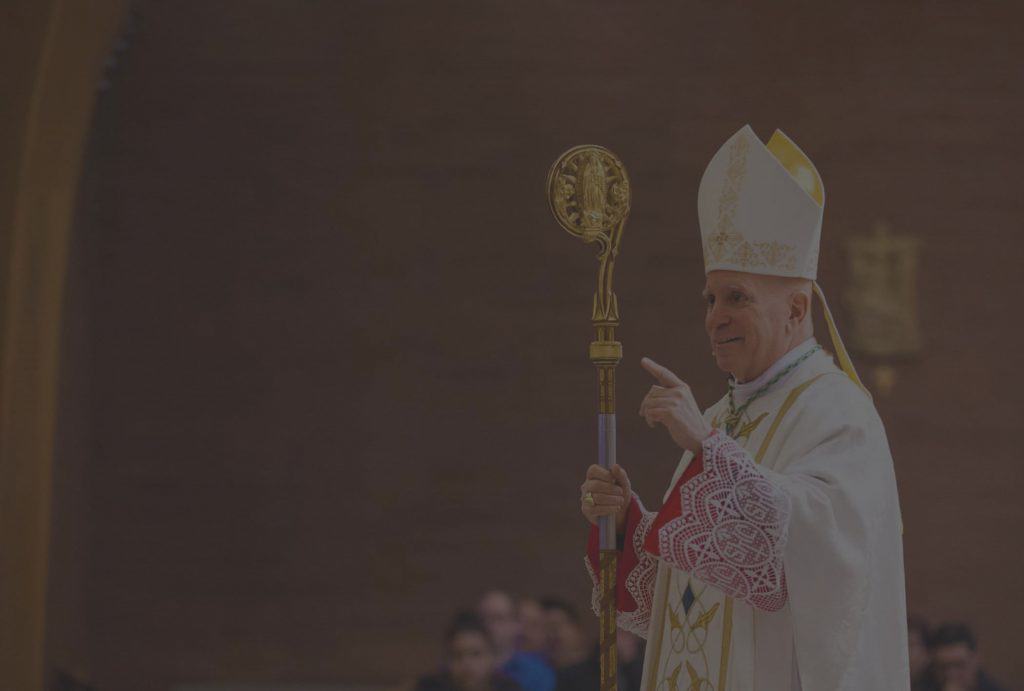

Fran Maier is our chancellor.
He'll MC tonight.
And Jim Tatten is executive
director of the Colorado Catholic Conference. Jim works for all three Colorado
Catholic bishops, not just the archdiocese. Jim represents all of us as our
registered lobbyist at the State Capitol. He's also an attorney.
OK. Let's talk about why
we're here. We're here for two reasons. First, for at least six months, people
have been asking me, "Archbishop, what should we do about the November
election?"
That's a good question.
A lot of important issues are at stake this year. If we're serious about our
faith, then our political choices should be formed and informed by our Catholic
convictions. All of our actions and all of our choices should be rooted in our
Catholic identity, and our relationship with God. That means our choices at
work; within our families; and also the choices we make in the exercise of our
citizenship. So we're here tonight first to remind ourselves how to think and
act as Catholics as we weigh the election and its choices.
The second reason is connected
to the first. We need to "think and act Catholic" every day of every
year. But even more so this year -- the Great Jubilee. Remember that the Catholic
idea of the Jubilee comes from the experience of the Jewish people. It's in
the Book of Leviticus, Chapter 25. The Jubilee was a time for the Chosen People
to repent; to center their lives in God; to forgive the debts of others; to
seek forgiveness for their own sins; and to work for justice among all the people.
What's that mean for us?
Citizenship in the Jubilee Year is an act of social responsibility and political
power in the presence of God. And when we step into the voting booth, we either
help to build His civilization of love . . . or its opposite.
Now, what are the guidelines
for tonight's discussion?
There's really just one.
I cannot, I will not, and I do not want to, tell you how to vote when it comes
to specific candidates or political parties. That's not the purpose of this
discussion. I am not a Democrat. I am not a Republican. And neither is the Church.
From the Catholic point of view, both major parties have strengths and weaknesses.
Both major parties have decent and well-meaning people among their candidates.
The job of connecting your Catholic faith with your specific political choices
is yours. So please don't ask me whether you should vote for Mr. Gore or Mr.
Bush, or which political party has the better platform. Legally, I can't answer
that -- and morally, that's your responsibility.
I will talk about what
the Church teaches, and where her priorities lie. I will talk about how to form
and inform a healthy Catholic conscience. I will talk about how we should apply
that to our citizenship. And at the end of my remarks I legally can -- and I
will -- talk about specific amendments on this year's ballot.
So let's begin with a little
bit of background. For Catholics, the job of good citizenship is a subset of
Catholic social doctrine. If you want Catholic social doctrine in a nutshell,
just read Mark 12:29-31. A scribe asks Jesus, "Which commandment is the
first of all?" And Jesus answers:
" . . . 'Hear o Israel,
the Lord your God, the Lord is one; and you shall love the Lord your God with
all your heart, and with all your soul, and with all your mind, and with all
your strength. The second is this: 'You shall love your neighbor as yourself.'
There is no other commandment greater than these."
Those of you who've been
through the Catholic Biblical School know what Jesus is doing here. He's being
a good young Jewish rabbi. He's reciting the shema, and quoting directly from
Deuteronomy and Leviticus. A Jewish man would repeat the shema - "Hear
o Israel, the Lord your God, the Lord is one" - many times a day. He would
do it to ground himself in the reality that only God is the center and meaning
of everything. Nothing should compete with Him; and when we forget Him, everything
starts to unravel.
In other words, the love
and justice we owe our neighbor is rooted in the love and obedience we owe to
God. The rights of other people come from the fact that we're all children of
the same Father. We're all created in His image. God owns life. We don't. That's
why the first principle of loving our neighbors is: Don't kill them. That's
why, in understanding the Ten Commandments, we should observe that the first
three commandments govern our fundamental relationship with God -- and only
because of them can the other seven govern our relationships with each other.
What's this got to do with
Election 2000? Actually, quite a lot. And here's why. God guarantees the "humanity"
of human society. All political authority derives its legitimacy from God's
authority - and is therefore accountable to Him. Without God, human authority
very quickly becomes inhumane. We can see this happening in our own country
today. That's why the Church always has a lot to say about culture, economics,
politics and social justice. That's part of her missionary mandate, and also
ours. The witness of the Church on "social issues" begins in Scripture,
runs through history in the papal encyclicals and the Second Vatican Council,
and continues today in documents like Living the Gospel of Life and Faithful
Citizenship.
Here's one example that
applies directly to our discussion tonight. About 40 years ago, Pope John XXIII
wrote a great encyclical letter on world peace called Pacem in Terris. But he
didn't begin it by talking about international relations. He began by talking
about the rights and duties of the individual human person -- and justice between
individuals, and within societies.
Why did he begin that way?
It's because the "big picture" depends on the "small picture."
World peace begins with a respect for the dignity of the individual human person.
John XXIII wrote that "every human being is a person" (9). And he
said that "every man has a right to life, to bodily integrity, and to the
means which are suitable to the proper development of life; these are primarily
food, clothing, shelter, rest, medical care, and finally the necessary social
services" (11).
The big picture depends
on the small picture. No amount of good policy on immigration, or unemployment,
or education, or housing, compensates for bad policy when it comes to killing
the innocent -- including the unborn. The right to life comes first. That's
the priority. It's the foundation of every other right. Without it, every other
right is built on sand. This is the core message of the U.S. bishops' 1998 pastoral
statement, Living the Gospel of Life. And that's why the Church is so adamant
about abortion and the other "life" issues.
Of course, if the "right
to life" is the only issue Catholics care about, that doesn't work either.
In Genesis 9:5, God says, "From man, in regard to his fellow man, I will
demand an accounting." When you go home tonight, reread the Epistle of
James. It'll take you just10 or15 minutes. And pay particular attention to James
2:15-17:
"If a brother or sister
is ill-clad and in lack of daily food, and one of you says to them, 'Go in peace,
be warmed and filled,' without giving them the things needed for the body, what
does it profit? So faith by itself, if it does not have works, is dead."
Vatican II teaches that
"the political community exists . . . for the common good [which] embraces
the sum total of all those conditions of social life which enable individuals,
families and organizations to achieve complete and efficacious fulfillment"
(GS, 74). It also teaches that, "Every citizen ought to be mindful of his
right and his duty to promote the common good by using his vote." (GS,
75).
Catholics have the right
and the obligation to demand that their public officials -- and their public
policies - should protect and encourage family life; should help the poor and
homeless; should promote economic justice both at home and abroad; and should
support the sick, the elderly, and children seeking a decent education.
This is the core message
of the U.S. bishops' Election Year message, Faithful Citizenship. It's not enough
to say, "Well, these are matters for private charity." Private charities
in this country are already overwhelmed by the demand. For Catholics, it's completely
proper for government to be involved in a serious way in solving these problems
- as long as the "solutions" don't promote killing the unborn and
the weak.
As Catholics we have an
obligation to vote. That means we also have an obligation to be informed about
what the candidates stand for -- and what the Catholic faith teaches. And don't
assume that newspapers and the television will give you the information you
need. Neil Postman once said that the main contribution television has made
to the American political process is this: It's made it impossible for a short,
fat, ugly person to be elected president - even if he has the genius of Einstein
and the sanctity of Mother Teresa.
We have the obligation
to read and reflect on what the Church teaches. At a minimum this year, that
means we should read and reflect on Living the Gospel of Life. And then, in
the light of that document and never separate from it, we should read and reflect
on Faithful Citizenship.
We also have the duty to
vote our conscience. But remember that for Catholics, conscience is never just
a matter of private feeling or opinion, or personal preference. Vatican II reminds
us that "in forming their consciences, the faithful must pay careful attention
to the sacred and certain teaching of the Church. For the Catholic Church is
by the will of Christ the teacher of truth" (DH, 14). If our private conscience
conflicts with the Church -- especially on an important teaching -- the problem
is probably not with the Church. It's more likely with our conscience.
We have a lot to talk about
tonight -- including the fact that we all face imperfect and complicated choices
as citizens, and "doing the right thing" may not be obvious. So I'm
going to stop here. But before I do, I want to comment on two of the amendments
on the ballot this November, because in a way they embody two key elements of
the Church's social teaching.
The Catholic bishops of
Colorado support Amendment 25, and I strongly urge you to vote for it. Amendment
25 will require physicians to provide important information to a woman before
performing an abortion. Women have a right to "informed consent" about
abortion. Women have a right not to be misled about what abortion entails. Amendment
25 will protect women, and it will save unborn lives. It's an important prolife
effort. Please give it your support.
The bishops also support
Amendment 22, and I strongly encourage you to vote for this one, as well. Amendment
22 will require background checks at gun shows. Like Amendment 25, it's also
thoroughly "prolife" - but in a different way. We have 200 million
guns in this country. Too many of those guns are illegal and used in violent
crimes. We're rightly committed to the safety of children in side the womb,
We also need to protect them once they're born. Amendment 22 is a reasonable
and prudent gun-safety measure which will help Colorado prevent the illegal
sale of firearms to minors and felons.
So, thank you for listening,
and let's go to question.